


You don’t need more strangers. You need your people to know how to help.
When I left corporate America after years at Boeing, Salesforce, and JPMorgan Chase to build my speaking and training business full time, I assumed the answer was more cold outreach. More DMs. More emails to strangers. More hoping and praying.
Then I looked at who I already knew: former colleagues, conference connections, mentors, people who had watched me speak or read my posts. They liked me. They trusted me. And almost none of them knew how to hire me or refer me.
That is the gap. Your network is not ignoring you. They are guessing at what you do and who you do it for.
One email changed that for me. Here is the exact system, so you can do the same.
Why warm outreach beats cold outreach
Cold outreach is a numbers game. Warm outreach is a relationship game, and you have already been playing it for years.
The goal is not to sell. The goal is to make it easy for people who already believe in you to act on your behalf: hire you, refer you, or open a door you did not know existed.
Here is the part most people miss. Referring you makes them look good. They get to be the person who knows the right expert and shares generously. Your job is to make that easy.
The biggest mistake: a vague ask
“Let me know if you hear of anything!” is the most common line in networking, and it almost never works.
People cannot refer a vague ask. If someone in their world needs a speaker or trainer, they will not connect that need to your email unless you named it.
My first draft was a long update about me. Feedback from a trusted colleague changed everything: stop telling people what I have been up to and start telling them exactly who I help. The final version was shorter, clearer, and every reader could picture someone they know that needed my services.
The 4-part outreach email
Short sentences. White space. Easy to read. Even easier to forward.
Say where you are and what you are asking for. One or two sentences. Introductions and referrals. Attach your one-sheet.
Name who you help. Three or four specific buyer types, each with a real outcome. This is the part that makes you referable.
Remove the geography excuse. Tell them your clients are everywhere and you work in person or virtually, so they share your name freely.
Offer a no-pressure next step. A link to a virtual coffee chat.
Step 1: Send one email to everyone in your network
I almost split my network into inner circle and broader network, with a personal line added for each group. Then I looked at the work involved and skipped it.
I wrote one email with no names in it and sent it to my whole list. It still worked.
Here’s the honest tradeoff. A personalized email will usually get more replies. But an email that goes out this week beats a perfect one that sits in drafts. If you have the energy, add one personal line to your closest 10 to 20 people. If you do not, send the same email to everyone and follow up one-on-one with the people who respond.
If you have not organized your network yet, start with my guide on turning your LinkedIn data into a warm lead list: You're Sitting on a Gold Mine: How to Turn Your LinkedIn Data Into a Warm Lead List in 3 Steps. It shows you how to find people in your professional network that you might have overlooked.
After that, ask your AI of choice to go through your emails for the past two years and create a list of people you’ve engaged with via email.
Step 2: Draft your email with AI
Copy this prompt into Claude or ChatGPT and fill in the brackets.
I am a [SPEAKER / TRAINER / CONSULTANT / COACH / AUTHOR]. I left [my corporate role, if true] to focus on [WHAT YOU DO]. Write a short, warm email to my existing network asking for introductions and referrals. It will go to my whole list, so do not use names or a mail merge.
Structure:
Opening: remind them I left [my role] to focus on [WHAT YOU DO] and ask for introductions and referrals. Link my one-sheet.
A bulleted list called “People who have benefited most from my services” with these buyer types: [BUYER TYPE 1], [BUYER TYPE 2], [BUYER TYPE 3], [BUYER TYPE 4]. Add one specific result or stat to each if I provide it: [STATS].
One sentence saying my clients are everywhere and I can work in person or virtually, so they should feel free to share my information.
An invitation to a virtual coffee chat using this link: [CALENDAR LINK].
Tone: warm, direct, and professional. Short sentences. No hype. Under 250 words. Do not use em-dashes.
Then edit it until it sounds like you. If you cannot picture a specific person while reading it, make the buyer types more specific.
Step 3: Send it the smart way
Send from your own email, not a bulk marketing tool. It feels personal and lands in the inbox.
Send in batches of 100 or less per day, don’t get your email address marked as spam. I scheduled mine for the morning of 5 consecutive days with it being sent to 95-98 people / email addresses each day.
Put everyone in BCC so nobody sees anyone else’s address.
BCC your CRM so every send is tracked automatically.
Link your one-sheet instead of attaching a heavy file. It is easier to forward.
Send it once. Let individual follow-ups do the rest.
The email I sent (as an example)
Here is my actual email. Use it as a model and replace the details with your own.
What to notice:
Every bullet names a buyer and an outcome. A reader can match each one to someone they know in seconds.
The stats do the selling. Real numbers, not adjectives.
The geography line gives permission. People will not share your name if they think you only work in your city.
There is one ask and one easy next step. Introductions, plus a coffee chat for anyone who wants to reconnect.
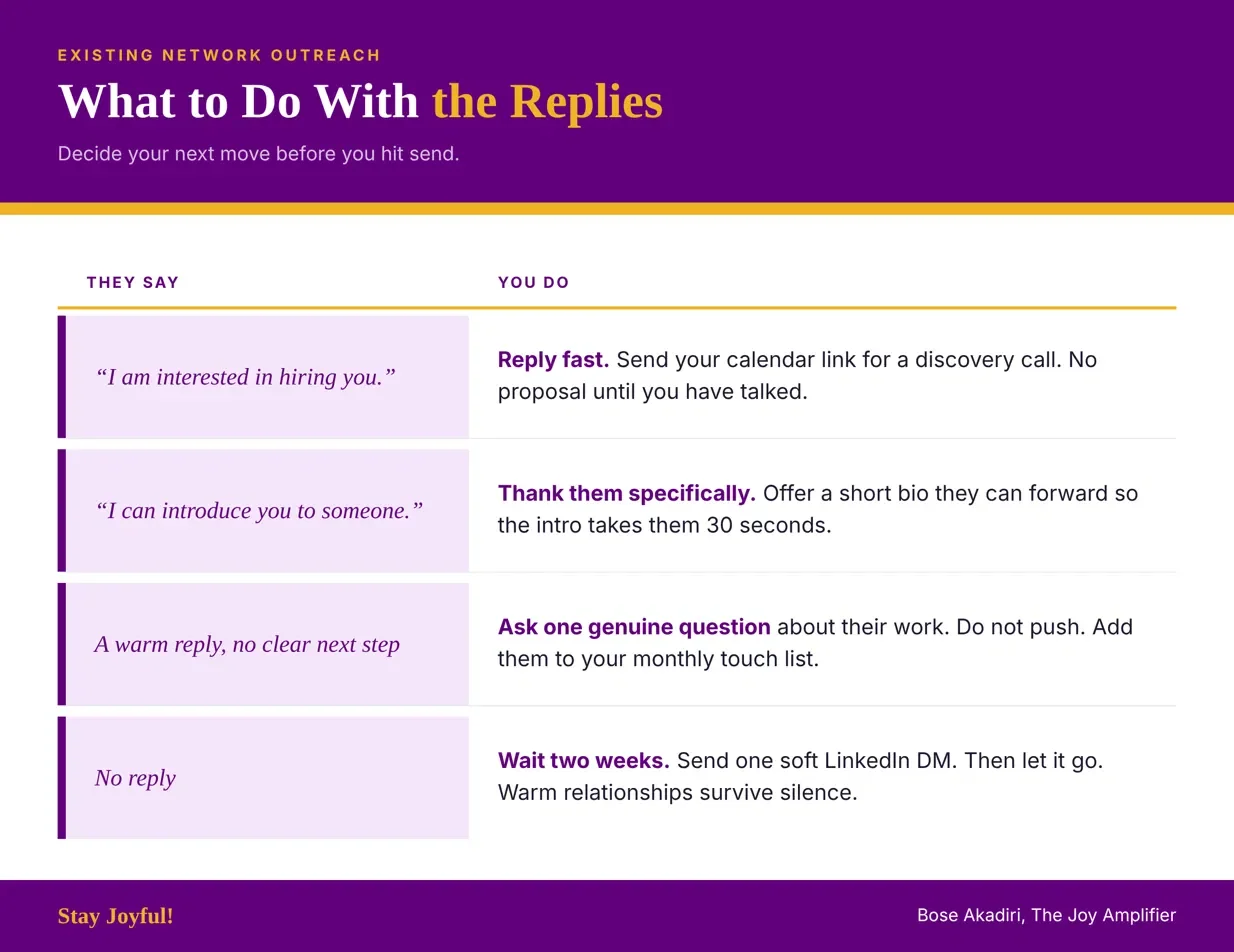
Step 4: Know what to do with the replies
Replies will fall into four buckets. Decide your next move before you hit send.
Step 5: Keep the relationship warm
One email will not do it alone. After the broadcast, use a monthly warm touch: a short message you send only when you have something real to share. A client win with the name left out. A feature you landed. A milestone for your book.
It’s not a newsletter and it’s not a pitch. It is a reminder that you exist and you are doing good work.
A simple cadence:
Broadcast email: once, then let follow-ups do the work
LinkedIn DMs: 10 to 15 a week, personal and sustainable
Monthly warm touch: once a month at most, tied to a real moment
Track it or lose it
The reason most outreach fizzles is not the email. It is the follow-up. Replies get buried, referrals go unthanked, and warm leads go cold.
Every contact needs a home: who they are, how you know them, what you sent, and what happens next. That is exactly why I built a CRM system for my own business.
Just left corporate, or planning to?
Knowing who to email is only half of it. The other half is deciding what you are building and who it is for, so your network can actually refer you.
That is what Life After Corporate is for. It is one of the four focus areas inside my Joy Jumpstart Intensives, one-on-one sessions where we work through your next chapter together. Choose the session that fits:
Clarity Call (45 minutes, $300): Get clear on what you are building and leave with one move to start.
Strategy Session (90 minutes, $500): Leave with a 90-day plan for your next chapter, including what to build, how to position yourself, and how to build momentum.
Both include a written recap. Spots are limited each month. Book your Life After Corporate session here.
Want the CRM template I use? I’m building a CRM template system specifically for speakers, trainers, consultants, and authors that integrates with this process. Join the waitlist and be the first to know when it is ready.
Bose Akadiri is The Joy Amplifier — a keynote speaker, corporate trainer, and author of the Amazon bestseller The Stay Joyful Method. She helps corporate leaders build joyful, high-performing teams without burnout.
Stay joyful!
Bose